

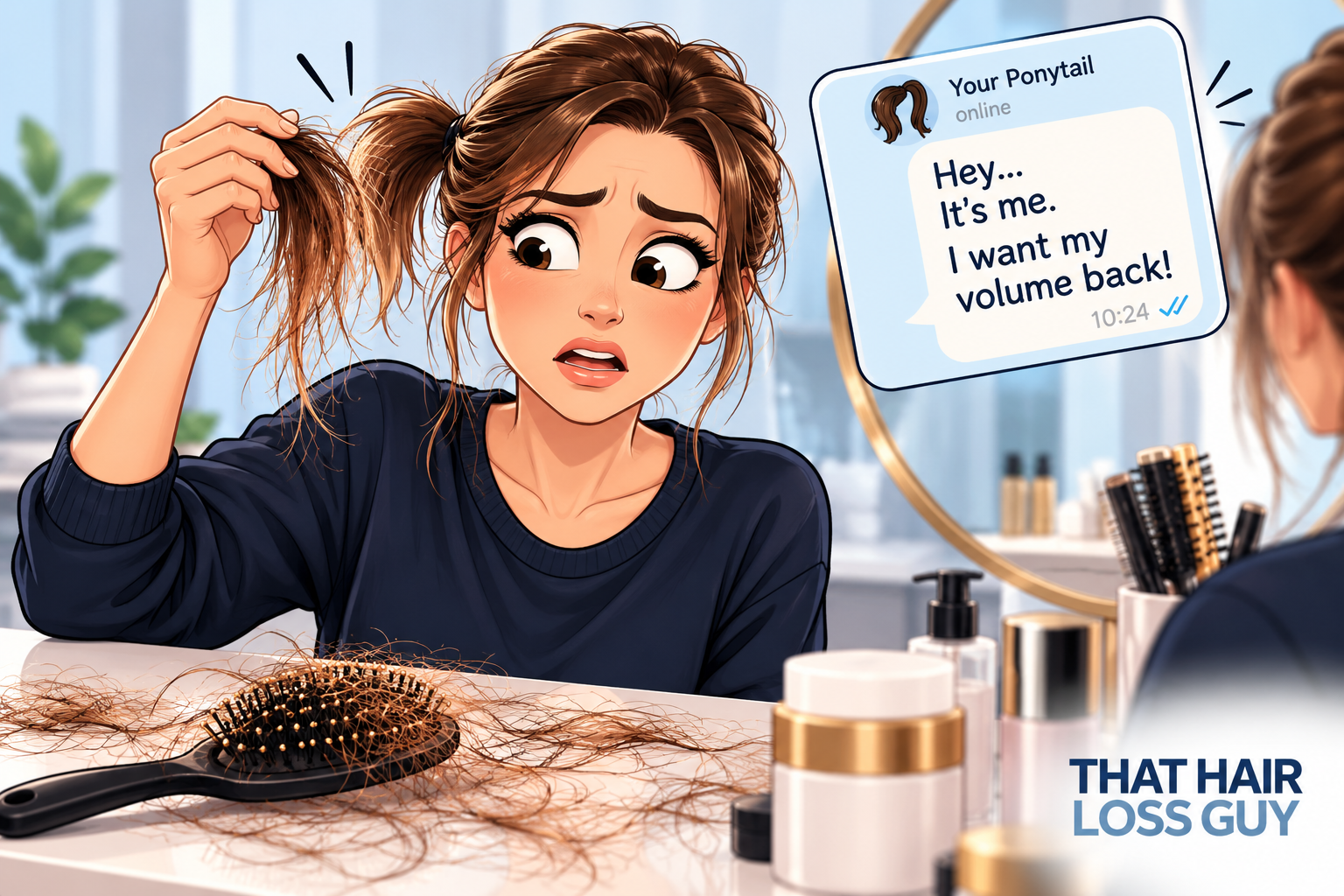
When your hair bobble needs one less loop, it might be time to pay attention.
I'm Eamonn Henry, That Hair Loss Guy at MHR Belfast. My aim is to help women understand why their hair might be thinning, what could be causing it and which options may help bring back their confidence — without the panic or pressure.
Have you noticed your ponytail looking a little less impressive lately? Perhaps your hair feels finer, your parting seems wider, or there’s more hair than usual gathering in your hairbrush or shower drain.
You might even find yourself doing that thing we’ve all done — holding up an old photograph and wondering, “Where has all my hair gone?”
If this sounds familiar, you’re not alone! Hair thinning affects women of different ages, and it can be upsetting (and sometimes a shock) when your hair starts to look or feel different from how it used to.
But before you panic-scroll your way through the internet, let’s look at what might be happening.
Why does your ponytail look thinner?
There isn’t one single cause of female hair thinning. Hair naturally changes over time, but a noticeable reduction in volume can have several explanations.
1. Hormones can play a part
Hormonal changes can affect the hair growth cycle. Pregnancy, the months following childbirth, perimenopause and menopause can all be associated with changes in hair density or shedding.
Some women notice that their hair feels finer around the crown or that their parting gradually becomes more visible.
2. Stress can show up in your hair
Your body sometimes responds to significant physical or emotional stress by shifting more hairs than usual into the shedding phase of the hair cycle.
This type of shedding may become noticeable a few months after the trigger. Illness, surgery, major life events and rapid weight loss can also contribute.
The frustrating part? You may have dealt with the stressful event already, only to notice your hair changing afterwards.
3. Genetics matter too (thanks family!)
Female pattern hair loss is a common cause of gradual thinning. It can run in families and often develops slowly, with reduced density around the crown or a widening parting.
It doesn’t necessarily mean you will develop the same hair loss pattern as another woman in your family, but genetics can influence your likelihood of experiencing it.
4. Your general health may be relevant
Low iron levels, thyroid problems, nutritional deficiencies and certain medications can contribute to hair loss or increased shedding.
If your hair has changed noticeably, it is worth speaking with MHR Belfast rather than simply buying every hair supplement that pops up on Tik Tok. The right approach depends on the underlying cause.
Is it shedding, thinning or both?
It helps to understand the difference.
Increased shedding means you are losing more hairs than usual. You might notice more hair in the shower, on your pillow or in your brush.
Gradual thinning means the overall density of your hair is reducing over time. Your parting may look wider, your scalp may be more visible, or your ponytail may feel smaller.
Sometimes these happen together. Working out which pattern you are experiencing can help guide the next steps.
What can you do about it?
First, don't assume that you have to live with it — but don't assume that one particular treatment will be right for everyone either.
Here are some sensible places to start:
Look for changes over time. Compare photographs taken in similar lighting and from similar angles rather than checking your hair every hour.
Be gentle with your hair. Avoid excessive heat, tight hairstyles and harsh treatments that may contribute to breakage.
Check your general health. Your GP can assess whether blood tests or a review of medication may be appropriate.
Get advice early. If the thinning is persistent or progressing, MHR Belfast can help you understand the likely cause and available options.
What about hair restoration treatments?
Once you have a better understanding of what may be causing the thinning, you can explore suitable options with MHR Belfast.
Depending on the cause and your individual circumstances, these may include:
Laser Hair Therapy: Low-level laser devices are used to support hair growth in some people with certain types of hair loss (usually thinning). Results vary with each individual but it is an effective treatment type to get density and volume back.
Hair Fusion: For suitable clients, non-surgical hair replacement or hair integration may help improve the appearance of density, while addressing the cosmetic impact of thinning.
Hair transplant: This may be an option for carefully selected women, but it is not suitable for every type of female hair loss. The cause, stability of the loss, donor hair quality and expected outcome all need to be assessed by a MHR Belfast specialist.
The key is finding an approach that suits your hair, your circumstances and your expectations — not choosing a treatment simply because it worked for someone else.
You don't have to wait until it's really noticeable
One of the most common things people do when they notice hair thinning is ignore it and hope it goes away.
Shedding is temporary and can improve once the trigger has passed. However, in other cases, getting advice earlier can help you understand what is happening and make informed decisions about your options.
You don't need to wait until your scalp is clearly visible or your ponytail has lost half its volume before asking questions. But even if you do take time to take the first step, MHR Belfast will be there for guidance and support.
A final word from That Hair Loss Guy
If your ponytail isn't quite what it used to be, don't panic — and definitely don't let Google, Tik Tok or Instagram convince you that you've got every hair loss condition under the sun!
Hair thinning can happen for lots of reasons, and the first step is understanding what's going on. Sometimes there's a straightforward explanation; other times, it takes a little more investigation.
My advice? Don't ignore it if you're concerned, don't jump into treatments without understanding the cause, and don't feel you have to figure it all out on your own. Book that consultation!
At MHR Belfast, I'm here to offer honest advice, explain the options and help you work out what might be right for you — without the pressure.
Until next time… Here's to happier hair days and ponytails with a little more oomph!