

The Hairline Has Left the Group Chat
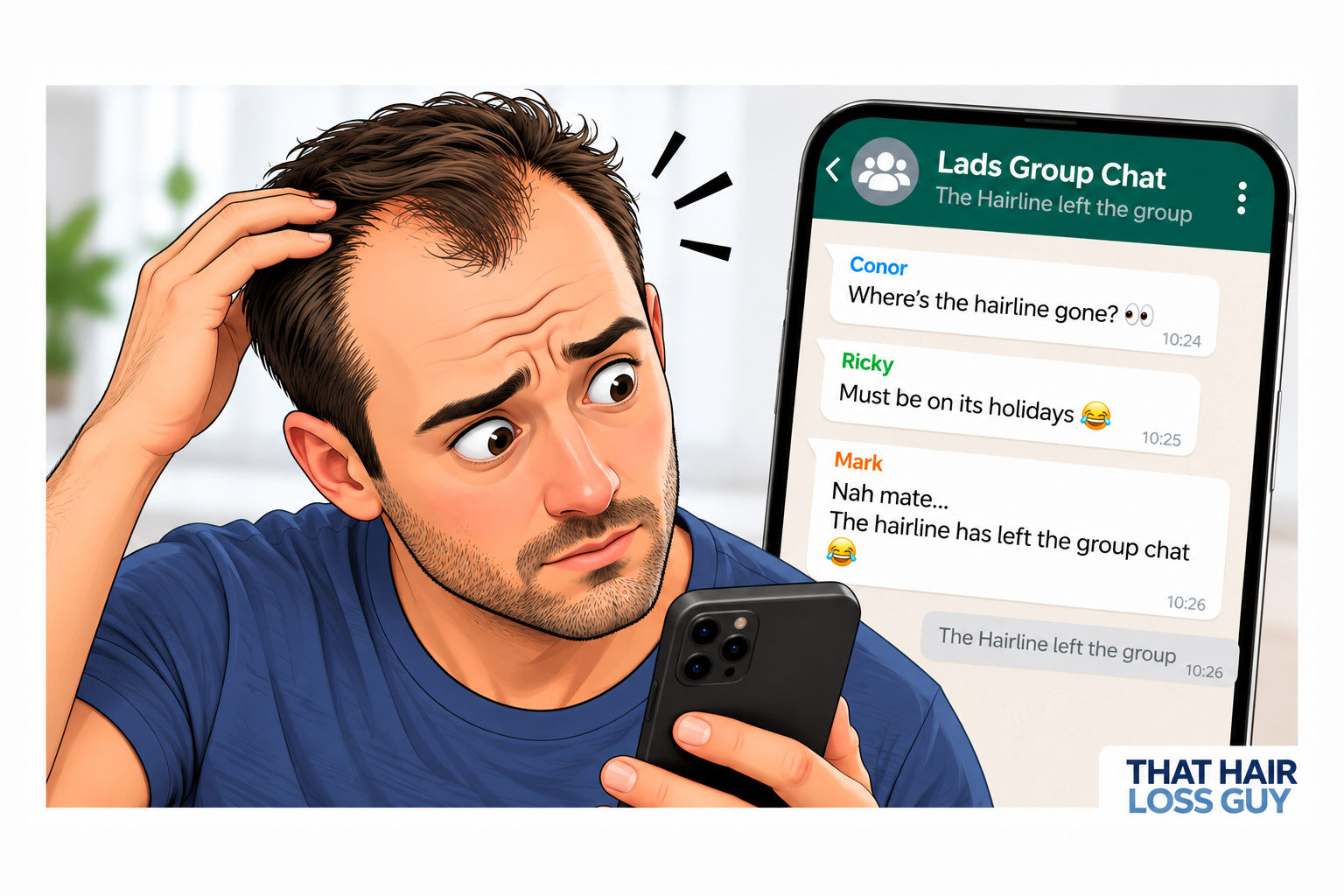
Less panic-scrolling. More straight answers. Here’s what you need to know about a receding hairline.
So, when did that happen?
One day, you’re styling your hair as usual. The next, you catch yourself checking your temples in every mirror, taking photos from increasingly questionable angles, or wondering if your forehead has somehow got bigger overnight.
Sound familiar? If your hairline seems to be moving backwards, you’re certainly not alone. A receding hairline is a common concern for men, but that doesn’t mean you have to ignore it, panic about it or believe everything you read online.
Let’s get to the root of what might be happening.
Why is your hairline receding?
There isn’t always one simple answer, but some causes are more common than others.
1. Genetics: thanks, family!
One of the most common reasons for a receding hairline is androgenetic alopecia, often called male pattern hair loss.
Your genes influence how sensitive your hair follicles are to hormones, particularly dihydrotestosterone (DHT). In susceptible follicles, this can gradually cause hairs to become finer, shorter and less visible over time.
You might notice the temples receding first, creating that familiar M-shaped hairline. For some men, thinning at the crown develops too.
And yes, family history can play a part. But it’s not as simple as blaming one side of the family!
2. Age: time waits for no hairline
Hairlines can change as we get older. Some men develop a slightly higher, more mature hairline, while others experience progressive hair loss.
The important distinction is whether your hairline has simply settled into a mature shape or whether you’re noticing ongoing thinning and recession.
A changing hairline doesn’t automatically mean you’ll lose all your hair. Everyone’s pattern and rate of change are different.
3. Stress and changes in your health
Significant stress, illness, surgery, medications and certain nutritional deficiencies can contribute to hair shedding.
This type of shedding can sometimes appear a few months after the triggering event. It often affects the scalp more generally rather than just the temples, although more than one type of hair loss can happen at the same time.
If your hair loss is sudden, patchy or accompanied by scalp irritation, or if you’re feeling unwell, it’s worth speaking with MHR Belfast, rather than assuming it’s simply a receding hairline.
4. Your hairline might not be the whole story
Sometimes the temples are the most noticeable area, but there may also be changes in density elsewhere on the scalp.
Looking at the overall pattern, how quickly it has changed and whether there are other symptoms can help establish what might be going on.
The takeaway? Before choosing a treatment, understand what you’re treating and that is where MHR Belfast can help.
Is it a receding hairline or a mature hairline?
This is where things get interesting.
A mature hairline is a normal change that can happen after adolescence. It often sits a little higher than a youthful hairline, particularly around the temples, and may then remain relatively stable.
A receding hairline caused by progressive hair loss tends to continue changing over time. You may notice the temples moving further back, hairs becoming finer or overall density decreasing.
If the change is worrying you, MHR Belfast can help you decide what assessment is needed.
Try not to check your hairline changes every day — hair changes are difficult to judge when you’re looking for them constantly!
Can you stop a receding hairline?
The honest answer is: it depends on the cause.
The earlier you understand it, the more options you may have. There are treatments that can help some people with hereditary hair loss, but no single approach works for everyone.
Treatments
Hair transplants
For suitable candidates, a hair transplant moves hair follicles from a donor area to areas affected by hair loss.
However, it isn’t a quick fix for everyone. Suitability depends on factors including the cause and stability of hair loss, donor hair availability and quality, expectations and the likelihood of future thinning.
At MHR Belfast we will explain the potential benefits, limitations and long-term plan — not just show you impressive before and after photographs.
Non-surgical options
Some people prefer to explore non-surgical approaches, depending on their type and stage of hair loss.
At MHR Belfast, we offer hair restoration options including Laser Hair Therapy. The evidence for treatments varies, and results are not guaranteed, so it’s important to understand what a particular treatment can realistically achieve before committing.
What should you do if your hairline is changing?
Here’s my advice:
Don’t panic. A changing hairline is common, and there may be several possible explanations.
Look at the bigger picture. Think about when the change started, whether it’s progressing and whether you have other symptoms.
Be cautious with miracle cures. Be sceptical of products promising instant regrowth or guaranteed results.
Get the right advice. Sudden or patchy hair loss, scalp symptoms or concerns about your general health deserve an assessment.
Explore your options before making a decision. Understand what each treatment can and cannot do, along with the costs, risks and maintenance involved.
A final word from That Hair Loss Guy
If your hairline is heading backwards (or looks like it wants to leave the group chat), you don’t need to spend the next six months analysing every selfie or ordering every product the internet throws at you.
Start with the facts. Understand what’s causing the change by contacting a hair loss specialist like MHR Belfast. Then decide whether you want to do anything about it.
And remember, there’s no rule that says you have to treat hair loss. The right decision is the one that suits you, your circumstances and your expectations.
If you’d like to understand your hair restoration options, MHR Belfast can help you explore what may be suitable for you, without pressure to commit.
Your hairline might have left the group chat. At least now, you know how to restart the conversation.