

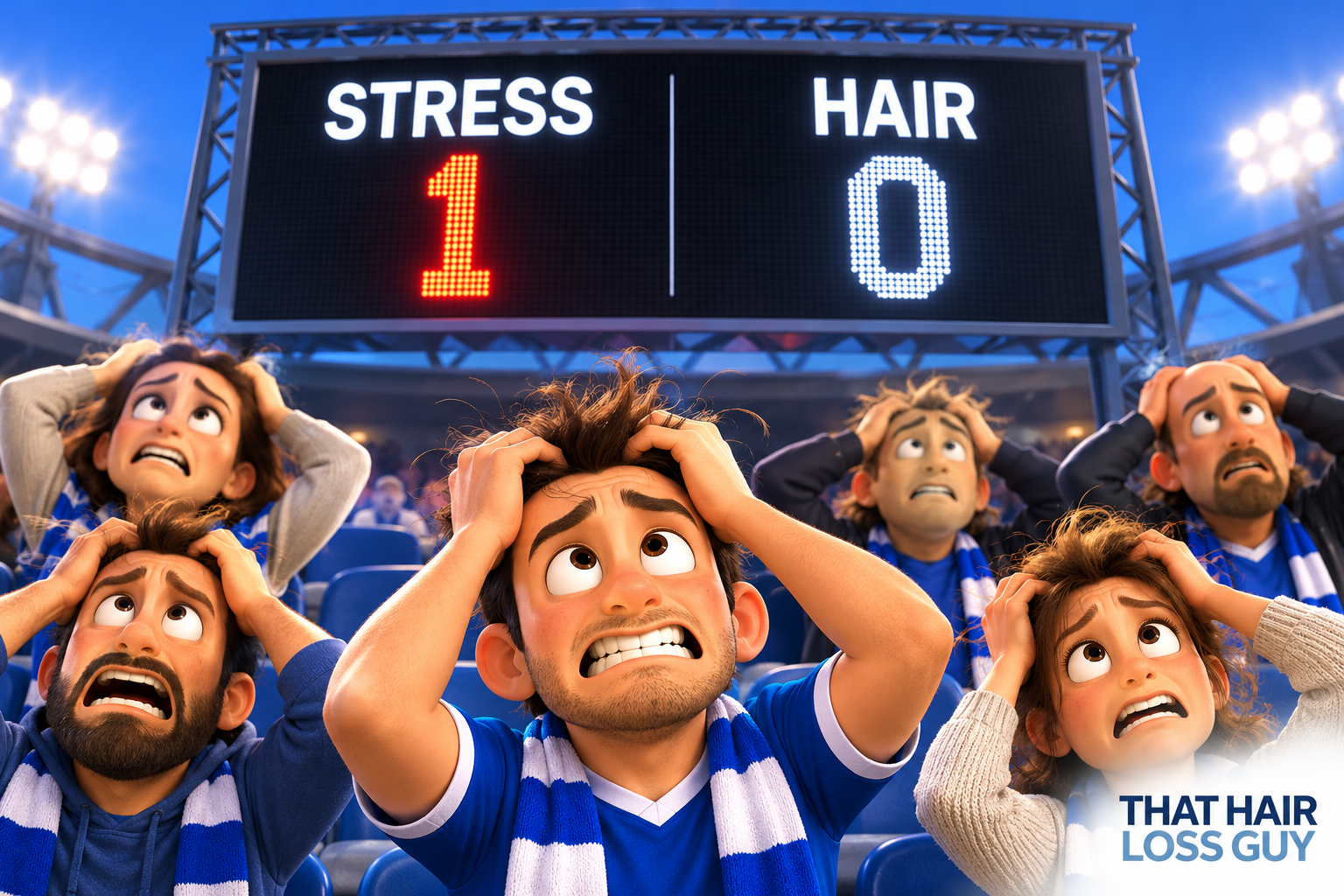
Hair meltdown? The surprising link between stress and hair shedding.
I'm Eamonn Henry, That Hair Loss Guy at MHR Belfast. My aim is to help you understand how stress can affect your hair, what's happening behind the scenes and what you can do about it — without adding more stress to the situation!
Ever had one of those weeks where everything seems to happen at once? Work is piling up, your to-do list is breeding overnight, your phone won't stop buzzing and even your five minutes of peace comes with a side of worrying about what you've forgotten.
And then, just when you think you've got enough on your plate, you notice more hair than usual in your brush.
Brilliant. Just what you needed.
But could stress really be affecting your hair? The short answer is yes, it can. The longer answer is a little more complicated — so let's get to the root of it.
Can stress actually make your hair fall out?
Unfortunately, it can.
Significant emotional stress or a major life event can disrupt the normal hair growth cycle and trigger a type of hair shedding known as telogen effluvium. Now, that's a bit of a mouthful, so let's keep it simple.
Your hair naturally goes through different stages: growing, resting and eventually shedding. That's completely normal. In fact, losing around 50–100 hairs a day is generally considered normal, although the amount varies between people.
However, after a period of significant stress, more hairs than usual can move into the resting phase. Those hairs may then shed several months later.
The result? More hair in your shower, more strands on your hairbrush and possibly a ponytail or hairstyle that doesn't feel quite as full as it used to.
And before you blame that one particularly awful Monday, remember that stress-related shedding is not always caused by one single event. It can follow a combination of pressures, illness or other changes affecting your body.
The plot twist you didn’t expect: Hair Loss can happen months later…
Here's the part that catches a lot of people out. You might have had a stressful period three months ago, finally feel as though life is settling down, and then suddenly notice your hair shedding more than usual.
Your first thought might be: Why is this happening now? I'm feeling better!
With telogen effluvium, increased shedding often becomes noticeable around two to three months after the trigger. That's because the hair cycle takes time to respond.
So, if you're trying to work out why your hair seems thinner today, think back over the previous few months rather than just the last few days.
Have you experienced any of the following?
A particularly stressful period at work or at home.
Bereavement, relationship difficulties or another major life event.
An illness, high fever or surgery.
Significant weight loss or a restrictive diet.
Changes in medication or a possible nutritional deficiency.
Stress may be part of the picture, but it isn't always the whole story.
Is it stress-related shedding or something else?
This is where it's important not to jump to conclusions.
Stress-related shedding often affects the scalp more generally, rather than causing one clearly defined bald patch. You may notice less volume overall, a thinner-looking ponytail or more hair coming away when washing and brushing.
However, other types of hair loss can look similar.
For example, male and female pattern hair loss can develop gradually, while certain conditions can cause distinct bald patches. It is also possible to have more than one type of hair loss at the same time.
Iron deficiency, thyroid problems, hormonal changes, illness, weight loss and some medicines can also contribute to hair shedding or thinning.
In other words, stress might be the culprit — but don't put it on trial and declare it guilty without looking at the evidence!
If you're noticing persistent or significant hair loss, your GP can help investigate possible causes and decide whether an examination or blood tests are appropriate.
Will my hair grow back?
Now for some reassuring news.
Stress-related telogen effluvium is often temporary. Once the trigger has passed and any underlying issues have been addressed, excessive shedding usually settles.
New hair can begin growing while you're still noticing shedding, but it takes time for that growth to become visible and for your hair to regain its previous volume.
The shedding phase commonly lasts around three to six months, although recovery varies. It can take several more months — sometimes longer — for your hair to feel as thick as it did before.
Unfortunately, hair doesn't work to our preferred deadlines. You can't send it a strongly worded email asking it to hurry up!
If the stress continues, shedding may last longer. And if the underlying cause is something else, such as iron deficiency or pattern hair loss, that will need to be considered too.
So, while there is reason to be hopeful, nobody should promise that every case of hair loss will resolve simply by reducing stress.
What can you do if stress is affecting your hair?
You can't always remove the stressful things happening in your life. But there are practical steps you can take to look after yourself and your hair while you work out what's going on.
1. Don't panic-scroll your way to a diagnosis
We've all been there. One search leads to another, and before you know it, you've convinced yourself that a few extra hairs mean the absolute worst.
The internet can provide useful information, but it cannot examine your scalp or establish the cause of your hair loss.
If you're worried, start with MHR Belfast for advice rather than trying to diagnose yourself at midnight.
2. Give your body the basics
Your hair needs adequate nutrition to grow. Aim for a balanced diet that includes enough protein and iron-rich foods, alongside a variety of other nutrients.
If you've been dieting, lost a significant amount of weight or suspect a deficiency, this is something you should tell us at MHR Belfast. Supplements are not a guaranteed fix, and taking high doses without a confirmed need isn't necessarily helpful.
3. Be kind to your hair
While you're noticing extra shedding, keep your haircare routine gentle.
Avoid aggressive brushing or pulling at knots.
Limit excessive heat from straighteners and hairdryers.
Be cautious with tight hairstyles that pull on your roots.
Avoid harsh chemical treatments if your hair feels fragile.
These steps won't cure stress-related shedding, but they can help minimise additional damage and breakage.
4. Take your stress seriously
Easier said than done, we know.
Getting enough rest, taking breaks, moving your body and talking to someone you trust may help you manage stressful periods. If stress is affecting your sleep, mood or ability to cope, consider speaking to your GP for support.
Reducing stress is worthwhile for your overall wellbeing, even though it doesn't guarantee that hair shedding will stop immediately.
And please don't feel that your hair loss is somehow your fault because you haven't relaxed enough. Life can be difficult, and you deserve support without adding guilt to the list.
5. Get advice before choosing a hair treatment
If your hair is thinning, the right next step depends on the cause. At MHR Belfast, we believe understanding the cause and discussing the available choices should come before rushing into a treatment.
A medical assessment by your GP can help identify potential factors leading to hair loss or shedding. If the shedding persists, your scalp becomes visibly thinner, you develop bald patches or you notice scalp pain, redness or scaling, seek medical advice.
Once you have a clearer idea of what's happening, you can explore suitable options.
The final word from That Hair Loss Guy
Stress can take a lot out of you — and sometimes, unfortunately, it can show up in your hair too.
But seeing extra strands in your brush doesn't automatically mean you're going bald, and it doesn't mean your hair is beyond help.
The important thing is to look at the bigger picture, consider what has changed over the past few months and get the right advice rather than assuming stress is the answer.
And remember, your hair is only one part of you. You don't need to have everything figured out today, and you certainly don't need to add worrying about worrying to your daily schedule.
Take a breath, look after yourself and get to the root of the problem. Because life's stressful enough without your hair adding to the drama!
Until next time, take a deep breath, keep your cool — and don't let stress have the last laugh!
Further reading
This article is for general information and is not a substitute for personalised medical advice.